



Coral Transplantation and Hatchling Release Highlight Wakatobi Wave 2026
- 06 Okt 2026 08:27 WIB
- Voice of Indonesia
Poin Utama
- Wakatobi Wave 2026 featured marine conservation activities alongside tourism events, including coral transplantation and sea turtle hatchling releases.
- Fifty coral transplantation structures containing 750 coral-fragment seedlings were deployed to help restore coral reef ecosystems in Wakatobi National Park.
- A total of 25 green turtle (Chelonia mydas) hatchlings were released at Wambuliga Beach during the festival.
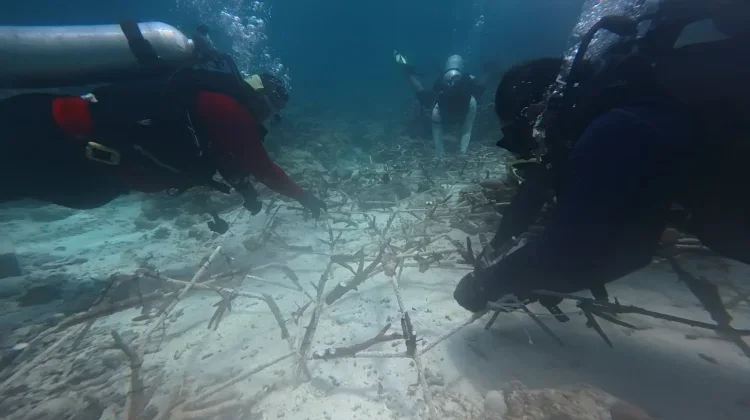
RRI.CO.ID, Kendari - In addition to tourism, marine environmental conservation was an important part of the Wakatobi Wonderful Festival and Expo (Wave) 2026 in Wangi-Wangi Subdistrict, Wakatobi Regency, Southeast Sulawesi Province. Conservation activities held during the October 2–4, 2026, event included coral transplantation and the release of sea turtle hatchlings.
The coral transplantation was held at the coastal area of the Maritime Center and the release of hatchlings along Wambuliga Beach in Sombu Village, Wangi-Wangi Subdistrict on Sunday, October 4, 2026. The activities are expected to improve the survival prospects of sea turtles while supporting the sustainability of marine ecosystems in Wakatobi National Park.
The Wave 2026 was organized through a collaboration between the Wakatobi Regency Administration, Wakatobi National Park Center, the Academy of Marine and Fisheries Studies (AKKP), and representatives of the Wakatobi Tourism Agency. The event was also supported by the World Wide Fund for Nature (WWF), the Nusantara Nature Conservation Foundation, and the FURAI Wakatobi Tourism Business Community.
Wakatobi Regent, Haliana, said the conservation activities complemented the festival, which is part of the national Kharisma Event Nusantara (KEN) program. She explained that strengthening Wakatobi’s tourism sector could not be separated from efforts to preserve the natural resources that serve as the region’s main attraction.
Haliana said the values underpinning environmental stewardship were part of the character and heritage of the Wakatobi people, passed down by their ancestors. “Wakatobi’s marine beauty and maritime culture are its comparative advantages and must be preserved sustainably. This has contributed to Wakatobi’s designation as one of Indonesia’s national priority tourism destinations,” she said.
Haliana added that the harmony between the marine environment and maritime culture reflected the ecological balance inherited from Wakatobi’s ancestors.
“This heritage is reflected in the way the people of Wakatobi view, manage and utilize natural resources while continuing to preserve them,” she said.
The head of Management Section I for Wangi-Wangi at the Wakatobi National Park Center, La Fasa, said 50 transplantation structures containing 750 coral-fragment seedlings had been deployed as part of the coral restoration effort.
“This transplantation activity is being carried out to restore coral reef ecosystems in the coastal waters of Wakatobi National Park. The site is also expected to become a tourism diving spot on Wangi-Wangi Island,” he said.
According to La Fasa, the activity was part of the conservation initiatives held during the Wakatobi Wave 2026 Festival. Meanwhile, 25 green turtle hatchlings (Chelonia mydas) were released during the festival.
“From 2011 through September 2026, a total of 6,839 hatchlings have been released into their natural habitat. The figure comprises 6,340 green turtles and 499 hawksbill turtles (Eretmochelys imbricata),” he said.
La Fasa said the Wakatobi National Park Center continued to strengthen sea turtle conservation efforts by releasing hatchlings produced through its Semi-Natural Turtle Hatching Demonstration Plot.
“The release of hatchlings is an important part of maintaining the populations of endangered sea turtles. Since only a small proportion of hatchlings survive to adulthood, every release represents an opportunity for a new generation of turtles to emerge,” he said.
“The released hatchlings were healthy green turtles, approximately four months old, measuring about 11 centimeters in length and 10 centimeters in width,” he added.
La Fasa explained that hatchlings were released in the morning or late afternoon to avoid intense sunlight and predator threats. Release sites were selected on clean beaches with direct access to the sea.
“The hatchlings were first placed in containers so they would not be touched directly and could avoid stress. They were then placed about one to two meters from the shoreline, facing the sea,” he said.
He further explained that the method gave the hatchlings an opportunity to register the physical conditions of the beach, or undergo imprinting, before entering the sea.
“After being released, the hatchlings were allowed to make their own way to the sea. Participants were also required to keep their distance so they would not step on or obstruct the hatchlings’ path. The National Park Center also expressed its gratitude for the support of all parties who helped make the activity possible,” he said. (Annaila Azzahra-EN)
News Recomendation
Memuat berita terbaru.....