



South Sumatra Emerges as Key Focus Despite Sharp Drop in National Hotspots
- 16 Sep 2026 17:55 WIB
- Voice of Indonesia
Poin Utama
- The Ministry of Forestry reported a nationwide decline in high-confidence hotspots to 1,037, though regional spikes occurred in Sumatra.
- Indonesian joint forces deployed 53 aircraft and integrated Japanese CH-47 Chinook helicopters for aerial firefighting operations.
- The government urged strict public compliance and field vigilance as dynamic haze affects regional air quality and visibility.
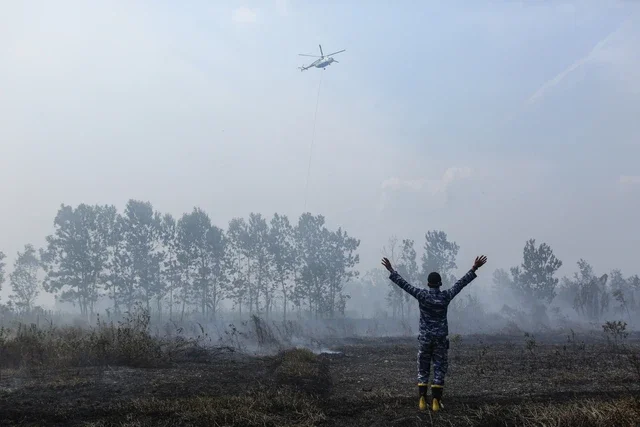
RRI.CO.ID, Jakarta - While Indonesia recorded a significant decline in high-confidence hotspots nationwide, authorities are shifting their attention to South Sumatra and Jambi, where hotspot numbers have risen even as conditions improve in several other fire-prone provinces.
According to a press release issued by the Indonesian Ministry of Forestry on Wednesay, September 16, 2026, high-confidence hotspots nationwide fell to 1,037 as of 9:05 p.m. Jakarta time on Tuesday, September 15, a decrease of around 400 hotspots from the previous day.
The decline was largely driven by improvements in Central Kalimantan and West Kalimantan, where intensive ground and air operations have continued in recent weeks.
Data from the ministry's SiPongi wildfire monitoring system, which relies on NASA Terra/Aqua, SNPP, and NOAA-20 satellite observations, showed that Central Kalimantan recorded 266 high-confidence hotspots, down sharply from 689 hotspots a day earlier.
West Kalimantan also saw a substantial decline, falling from 203 hotspots to 43. South Kalimantan recorded 72 hotspots, down from 112.
However, the trend was different in Sumatra. South Sumatra reported 245 hotspots, up from 116 previously, while Jambi recorded 62 hotspots, a significant increase from just nine hotspots a day earlier. Riau, which had previously remained free of high-confidence hotspots, reported 15 hotspots.
The Ministry of Forestry said the increase in South Sumatra and Jambi has become a priority in determining patrol routes, field verification efforts, and firefighting operations.
With 245 high-confidence hotspots, South Sumatra is now approaching Central Kalimantan's hotspot count, highlighting the need for continued vigilance despite the national decline.
Authorities reiterated that hotspots represent satellite-detected surface temperature anomalies and do not necessarily correspond to individual fire incidents.
"A single wildfire can generate multiple hotspot detections, which is why every indication continues to be verified through ground inspections and field monitoring," the press released stated.
To contain forest and land fires, Manggala Agni personnel are working alongside the Indonesian Military (TNI), National Police, National Disaster Mitigation Agency (BNPB), Meteorology, Climatology and Geophysics Agency (BMKG), regional disaster agencies, local administrations, communities, and private sector stakeholders.
Activities include patrols, ground checks, direct firefighting, firebreak construction, mopping-up operations, wetting efforts, and cooling measures.
The government has maintained the deployment of 53 aircraft to support wildfire control operations across the six priority provinces. Of those, 34 aircraft are assigned to water bombing missions, while 19 are used for aerial patrols and Weather Modification Operations (OMC).
Aircraft deployment is adjusted according to hotspot developments, field verification results, fire conditions, and weather patterns.
Weather modification remains part of the government's broader wildfire mitigation strategy, particularly for peatland wetting.
BMKG forecasts indicate that West Kalimantan and Central Kalimantan may experience moderate to heavy rainfall on September 16, conditions that authorities are monitoring closely as part of ongoing suppression efforts.
Air support has also been strengthened through cooperation with Japan. On Tuesday, Defense Minister Sjafrie Sjamsoeddin inspected the Japan Maritime Self-Defense Force vessel JS Kunisaki and three CH-47 Chinook helicopters in Mempawah, West Kalimantan.
The helicopters have been positioned to support wildfire suppression efforts in the province and are being integrated into Indonesia's wider firefighting operations, including flight coordination and safety management.
The expanded operations also align with President Prabowo Subianto's directive that every hotspot be addressed as early as possible before developing into a larger fire. The President has also emphasized public education and stronger law enforcement against deliberate burning, including cases involving corporations.
Despite improvements in hotspot numbers, authorities stressed that wildfire conditions cannot be assessed solely through hotspot data. Air quality, smoke distribution, weather conditions, rainfall, wind direction, visibility, and on-the-ground fire activity remain key indicators in evaluating the overall situation.
PM2.5 monitoring continues to show mixed conditions across Indonesia. While most areas remain within good to moderate air quality categories, parts of Sumatra and Kalimantan continue to experience unhealthy to very unhealthy conditions, with limited areas still classified as hazardous.
BMKG aviation weather monitoring on the evening of September 15 also indicated varying visibility conditions across priority provinces. Pontianak in West Kalimantan, recorded visibility of approximately two kilometers with smoky conditions, while Palangka Raya in Central Kalimantan reported around eight kilometers under cloudy skies.
Visibility in Banjarmasin in South Kalimantan, reached roughly nine kilometers with partly cloudy conditions, Jambi seven kilometers, Pekanbaru in Riau eight kilometers, and Palembang in South Sumatra more than 10 kilometers.
Among those locations, Pontianak remains an area of concern because haze continues to restrict visibility. Authorities noted, however, that visibility conditions remain highly dynamic and can change rapidly depending on smoke concentration, wind patterns, humidity levels, and rainfall.
The Ministry of Forestry has urged residents in affected areas to continue monitoring air quality conditions. If air quality deteriorates, people are advised to limit outdoor activities and wear masks when necessary.
Particular caution is recommended for children, pregnant women, older adults, and individuals with respiratory illnesses or other chronic health conditions.
The ministry also renewed its appeal to the public and businesses not to clear land through burning. Residents are encouraged to immediately report any signs of smoke, fire, or burning activity so that authorities can respond before small incidents develop into larger forest and land fires. ***
News Recomendation
Memuat berita terbaru.....