



September Night Sky: Harvest Moon Venus Auroras
- 07 Sep 2026 20:33 WIB
- Voice of Indonesia
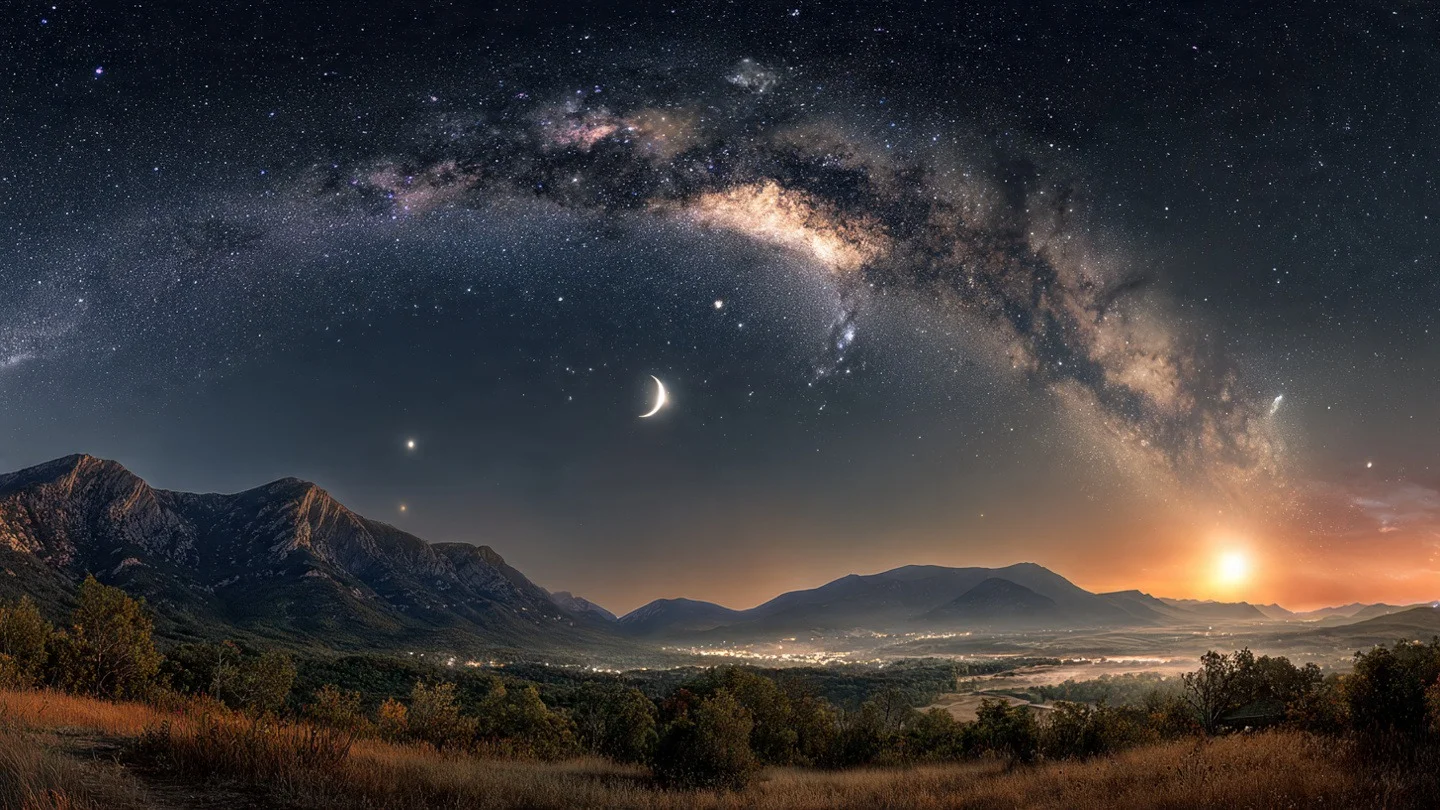
RRI.CO.ID, Jakarta: September brings a packed line-up of celestial events, from glowing planet-moon meetups to excellent Milky Way viewing and the start of prime aurora season. While August’s total solar eclipse set a high bar, this month offers its own highlights, including Venus at its brightest and multiple planetary alignments. It also marks the start of autumn in the Northern Hemisphere, a time when Earth’s tilt often enhances powerful northern lights displays. Here’s what to watch for and when to look up.
The month opens with a Moon-Mars conjunction on 6-7 September. The slim crescent moon and Mars will appear within about three degrees of each other in the pre-dawn sky. Look above the eastern horizon around 3 a.m. local time. Roughly 90 minutes later, Jupiter is forming a diagonal line with them, with Saturn also visible in the southwest. The planets will remain in view until sunrise. Then on 8 September, the moon meets Jupiter a few hours before dawn, traveling above the eastern horizon and visible until the sun comes up.
For the darkest skies, aim for the new moon on 11-12 September. With virtually no moonlight, this is one of the last chances in 2026 to see the bright core of the Milky Way in the Northern Hemisphere. Pair the darkness with a remote location like a national park and you may spot galaxies, nebulae, and the galaxy’s vivid centre. After November, the Milky Way core won’t be visible again until spring. Then on 14 September, the evening dusk gets an upgrade as a thin crescent moon passes within five degrees of Venus above the western horizon, about an hour after sunset.
Venus itself takes centre stage on 18 September, when it reaches peak luminosity for its 2026 evening apparition at magnitude -4.8. While the difference from nearby nights is subtle, Venus will be one of the easiest objects to spot, shining just after sunset near the western horizon. Don’t miss Mercury positioned beside it. This brightness makes Venus stand out even in light-polluted cities and marks one of the planet’s most dazzling appearances of the year.
The autumn equinox arrives on the evening of 22 September, officially starting fall in the Northern Hemisphere. Along with changing leaves, the equinox often brings an uptick in aurora activity. Earth’s tilt at this time creates more favourable conditions for solar wind to interact with our magnetic field. While auroras are hard to predict, Arctic and high-latitude regions may see impressive displays. Although we’re past the 11-year solar maximum peak, 2026 could still deliver strong northern lights shows as the season begins.
Later in the month, Mars joins the Gemini twins on 25 September. In the pre-dawn eastern sky, Castor and Pollux will appear with Mars aligned almost perfectly below them, forming a clear trio. Castor will sit at the top, Pollux in the middle, and orange-tinged Mars beneath. Look lower in the sky to catch bright Jupiter near the horizon as well. Then on 26 September, the full Harvest Moon rises. It peaks just before 1 p.m. ET but looks largest and most orange as it rises at sunset or sets at sunrise due to the moon illusion.
The Harvest Moon won’t be alone. Saturn will follow shortly after moonrise and the two will drift within six degrees of each other all night. Telescope users may even spot Neptune nearby. For deep-sky observers, the Andromeda Galaxy is a top target all month. As the closest major galaxy to the Milky Way, it appears as a faint smudge to the naked eye under dark skies but looks much better through binoculars or a small telescope. It’s best viewed around midnight or 1 a.m. when it’s highest overhead.
Source : Nat Geo
News Recomendation
Memuat berita terbaru.....