



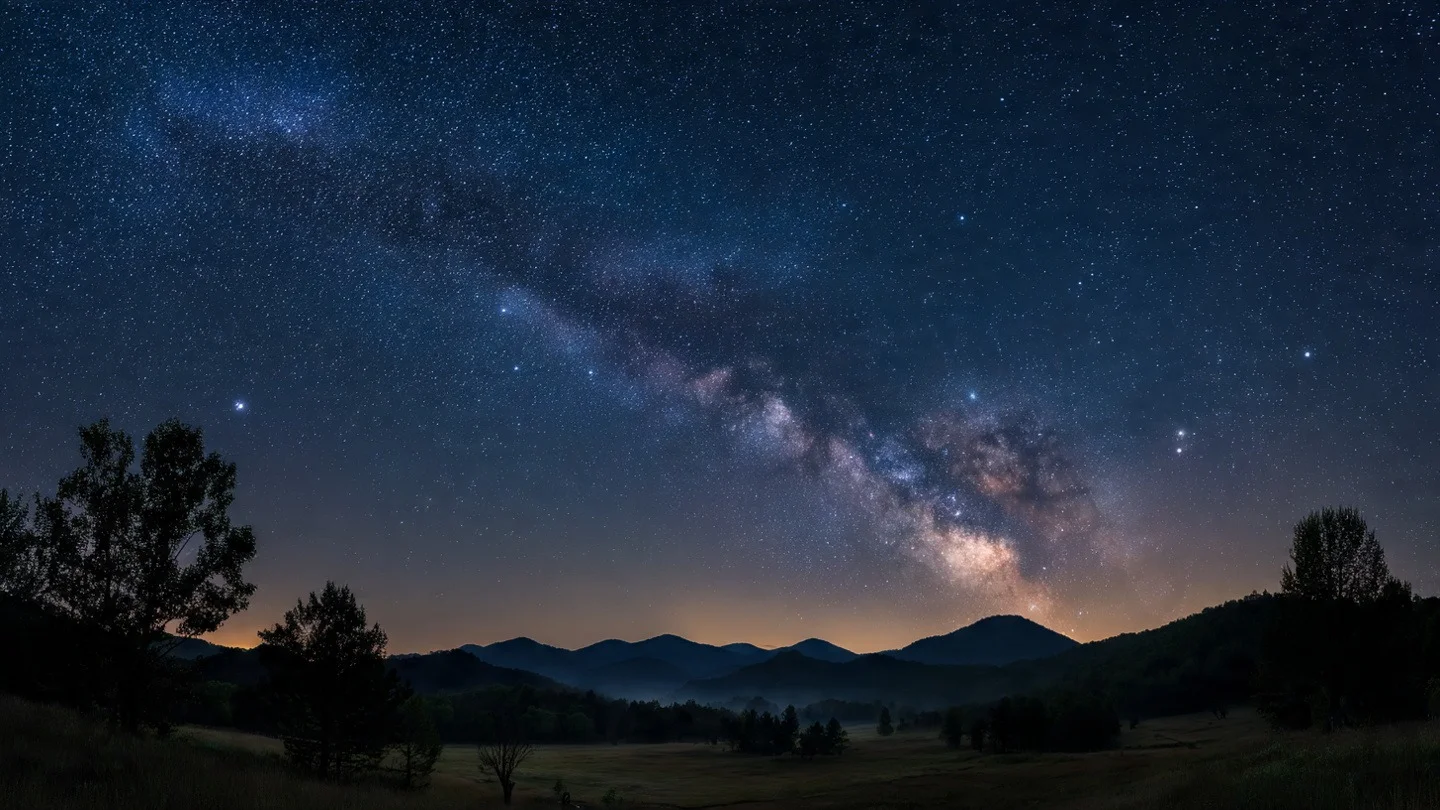
RRI.CO.ID, Jakarta : Finding your way around the night sky can feel overwhelming if you are new to stargazing. But August offers a perfect starting point with three exceptionally bright stars. Vega, Deneb, and Altair form the Summer Triangle, a huge asterism that rises high in the evening sky across much of the Northern Hemisphere.
Once you spot it, this pattern becomes a reliable guide to constellations, deep-sky objects, and the Milky Way, and it is also one of the most photogenic regions of the summer sky.
The Summer Triangle is not a constellation but an asterism, or a recognizable pattern of stars. Begin with Vega, one of the brightest stars visible from Earth. In mid-August, observers in the Northern Hemisphere will find it nearly overhead after dark.
Look to one side for Deneb, and farther away for Altair, which completes the large, elongated triangle. The pattern is much bigger than most first-time spotters expect. Held at arm’s length, a hand cannot cover it, so scan a wide expanse of sky instead of looking for a compact shape.
Once you locate the triangle, use its stars to navigate. Vega marks Lyra, a small constellation often drawn as a harp. Deneb forms part of Cygnus, the swan, whose brightest stars make a cross-shaped pattern known as the Northern Cross. Altair belongs to Aquila, the eagle, and is flanked by two fainter stars that help it stand out.
From there you can hop to smaller patterns nearby, like Sagitta, the arrow, and Delphinus, the dolphin. With binoculars or a small telescope you can also find the Dumbbell Nebula in Vulpecula and the globular cluster Messier 71 in Sagitta.
Under dark skies, the Milky Way appears as a faint, cloudy band running directly through the Summer Triangle. While the bright galactic core lies farther south toward Sagittarius, the section crossing the triangle is rich with star fields and lanes of interstellar dust.
This makes the area a natural classroom for learning how constellations connect to the larger structure of our galaxy, and why dark locations matter so much for seeing detail.
The combination of three bright stars and the Milky Way also makes the Summer Triangle ideal for beginner astrophotography. Plan around the moon, since the darkest skies around a new moon give the best results. Scout a location with low light pollution and check weather for clear skies, low humidity, and calm winds.
When composing, include a foreground element like a tree line, mountain, or building to convey scale and
the connection between Earth and the cosmos. Apps such as Star Walk and Photo Pills can help you line up celestial events with your exact location.
You do not need expensive gear to start. Many newer smartphones can capture the Milky Way in night mode if you stabilize them on a tripod. For a dedicated camera, use a wide-angle lens with a wide aperture on a sturdy tripod, and try exposures of about 10 to 20 seconds.
Autofocus often fails in the dark, so switch to manual focus. Zoom in on Vega or another bright star on your screen, then adjust the focus ring until the star looks sharp. Always review your first shot to confirm focus before packing up.
Start with the Summer Triangle and let it unlock the rest of the sky. It points you to Lyra, Cygnus, and Aquila, guides you into the Milky Way, and gives you bright targets to practice photography. On clear August nights it is both a map and a subject, turning a confusing sky into something familiar. Find Vega overhead, trace the triangle to Deneb and Altair, and from there the universe starts to make sense.
source : Nat Geo
News Recomendation
Memuat berita terbaru.....