



Domang the Elephant Boosts Action for Indonesia's Endangered Species
- 12 Agt 2026 20:56 WIB
- Voice of Indonesia
Poin Utama
- Domang, a young Sumatran elephant from Tesso Nilo National Park, has gained millions of followers on social media and is helping raise awareness about elephant conservation.
- Indonesia has approximately 1,100 wild Sumatran elephants across 21 landscapes as of July 2026, down sharply from an estimated 2,400–2,800 elephants in 2007.
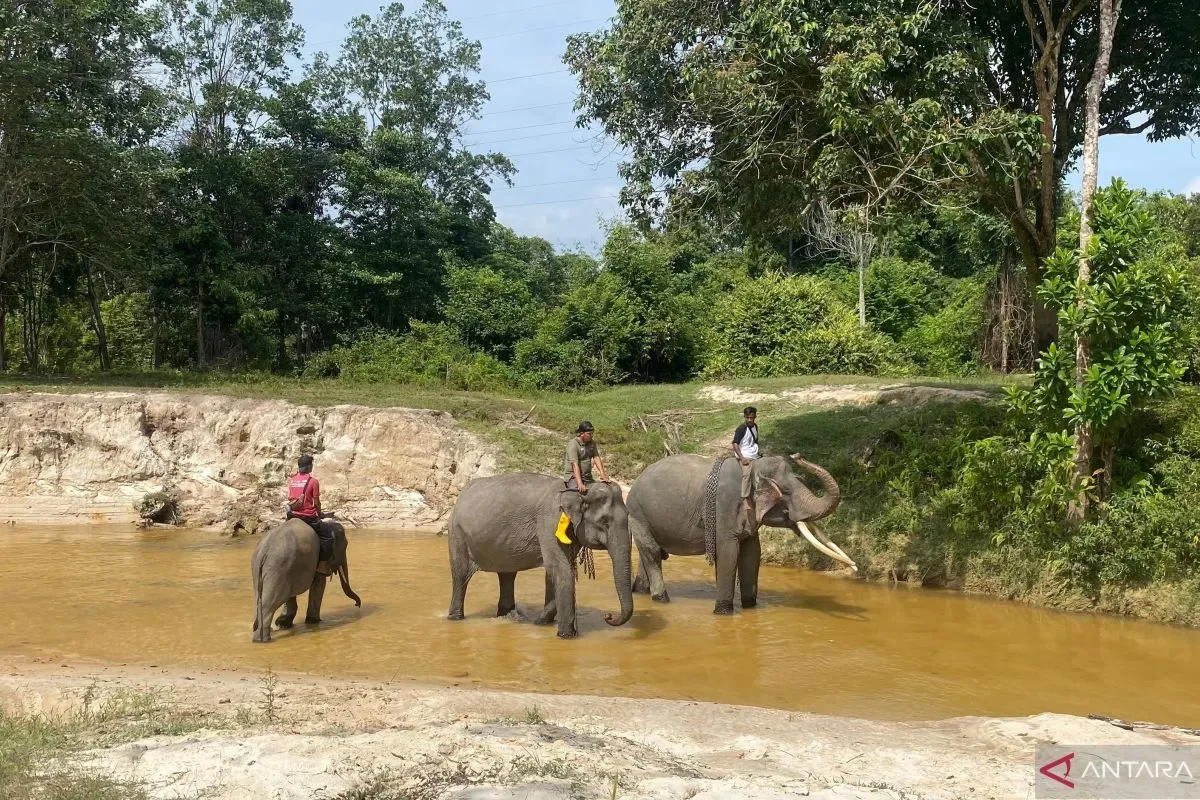
RRI.CO.ID, Jakarta - The endearing charm of Domang, an “online baby” from Tesso Nilo National Park in Riau Province, has captured the attention of millions of netizens across social media. The online popularity of this young elephant is now serving as a vital catalyst to transform sympathy on smartphone screens into tangible action to save the remaining 1,100 wild Sumatran elephants.
Through the official social media channels of Tesso Nilo National Park, the public has followed Domang’s growth and playful antics. Born on December 2, 2021, this elephant has become one of the most recognizable “online elephant celebrities” in the archipelago.
Domang’s fame has heightened public awareness of one of Indonesia’s protected species now facing the threat of extinction. These species include the Sumatran elephant (Elephas maximus sumatranus) and the Bornean elephant, both subspecies of the Asian elephant (Elephas maximus).
All elephant species in Indonesia are currently listed on the International Union for Conservation of Nature (IUCN) Red List as critically endangered in the wild.
According to data from the Ministry of Forestry, there are now approximately 21 elephant ranges on Sumatra, with a population of around 1,100 individuals as of July 2026. This figure represents a drastic decline from 42 ranges with an estimated 2,400–2,800 elephants in 2007. Meanwhile, in Kalimantan, an estimated 30–80 elephants are recorded within Indonesian territory.
Given these facts, World Elephant Day 2026, observed every August 12, can serve as a momentum to intensify rescue efforts and bolster the population of Indonesia’s largest land mammal.
Several factors continue to threaten these “forest farmers,” beginning with the shrinking of their roaming space due to forest conversion into palm oil plantations. In addition, road construction and settlement expansion have often proceeded without considering elephant migration routes.
Large-scale development without planning that accounts for the sustainability of elephant populations has created new problems. Habitat fragmentation isolates elephant groups as their corridors turn into plantations, residential areas, and even toll roads. This condition simultaneously increases the potential for negative human–elephant interactions.
When populations are split into small groups, the risk of inbreeding rises. In the long term, this can reduce genetic diversity, increase the likelihood of birth defects, and weaken immune systems.
Beyond development pressures, illegal poaching continues to loom over the species. Persistent beliefs that elephant tusks possess health benefits keep them as commodities in the international black market.
In addition to external threats, Indonesian elephants also face health challenges, notably Elephant Endotheliotropic Herpesvirus (EEHV), which has caused calf deaths in several conservation areas. Cases have affected elephants such as Tari in Tesso Nilo National Park and Laila at the Sebanga Elephant Conservation Center in Riau.
Forestry Minister, Raja Juli Antoni, recently highlighted the discovery of an elephant carcass on a palm oil plantation in Aceh, conveyed that the incident shows there is still much to improve in Indonesia’s conservation efforts. He cited a Ministry of Forestry publication reporting at least six elephant deaths between November 2025 and June 2026.
The discovery of elephant carcasses, and those of other protected species, within plantation and mining concessions sends a strong signal. It underscores the urgent need to more seriously restore forest areas as safe habitats for both wildlife and people.
Attention to the fate of Indonesia’s elephants has entered a new chapter, marked by the issuance of Presidential Instruction (Inpres) No. 8/2026 on the Conservation of the Population and Habitat of Sumatran and Bornean Elephants.
As reported by Antara, the instruction directs nine ministries, the National Police, and regional heads to undertake elephant landscape rescue efforts. The targets include 21 Sumatran elephant landscapes covering 5,437,213 hectares and one Bornean elephant landscape spanning 19,141 hectares.
A key focus of the instruction is the halt on issuing new permits for forest area utilization within elephant habitats. The government is also tasked with developing and implementing a Conservation Strategy and Action Plan for Sumatran and Bornean Elephants, as well as a Roadmap for Mitigating Human–Elephant Conflict.
The moratorium on new permits is not entirely new. A similar policy was implemented through the palm oil licensing moratorium under Presidential Instruction No. 8 of 2018, which expired in September 2021.
Another area requiring reinforcement is the expansion of preservation zones. These may include buffer areas around conservation zones, ecological corridors, high conservation value areas, community-managed conservation lands, and locally based protection areas.
Particularly for locally based protection areas, this approach can strengthen the sense of ownership among communities living within elephant habitats. It also helps revive traditional bonds between indigenous peoples of Sumatra and Kalimantan and the elephants with whom they have historically coexisted.
Cross-sector collaboration is essential to ensure the success of the Elephant Population Rescue Presidential Instruction. Plantation businesses, for instance, are expected to fulfill their obligations to identify and manage high conservation value areas and obtain Indonesian Sustainable Palm Oil (ISPO) certification, which places biodiversity management as one of its core principles.
Similar strict measures need to be applied in the energy sector. Businesses should not only be required to manage biodiversity but also to exercise selectivity in the issuance of new operational areas.
Spatial planning also demands attention. Regional Spatial Plans (RTRW) should not designate areas with intensive human activity within elephant corridors or near habitat pockets.
Some concrete steps are already visible. One example is the cooperation between the Indonesian and British governments prioritizing the development of the Peusangan Elephant Conservation Initiative (PECI) in Aceh.
Through this program, habitat protection, sustainable landscape management, and the reduction of human–wildlife conflict are being pursued in the Peusangan area of Aceh. In its initial phase, PECI implementation covers an area of 20,000 hectares, with potential expansion up to 80,000 hectares to form an integrated ecological corridor.
As of February 2026, PECI is in the implementation preparation stage, including institutional structure formation and technical planning. This phase also involves strengthening coordination among the government, development partners, the private sector, and local communities.
Beyond habitat work, the Indonesian government has partnered with veterinarians from India’s Vantara Elephant Hospital to conduct medical analysis and preventive actions to curb the spread of EEHV among elephants in conservation centers.
This collaboration began at the Buluh Cina Nature Tourism Park (TWA) and is planned to expand to elephant pockets in Tesso Nilo National Park, Sebanga, Way Kambas, and other locations.
The concept of wildlife crossing bridges is also being applied through the construction of elephant tunnels as crossing points along the Pekanbaru–Dumai Toll Road section, known as the Permai Toll Road. This demonstrates that infrastructure development does not always have to come at the expense of wildlife populations.
Meanwhile, a cultural approach is being introduced in Riau, initiated by several nonprofit organizations since 2021. Conservation outreach includes presenting elephants as datuk godang or great elder, referencing the honorific datuk in Riau society bestowed upon respected elders.
By framing elephants as datuk within Riau culture, communities are expected to accord them greater respect and view elephants as an inseparable part of their cultural heritage.
These examples show that elephant conservation can succeed when pursued collectively. The effort requires engagement from government down to grassroots communities, supported by the business sector and under strict oversight by relevant authorities.
If these measures continue consistently, the goal of saving Indonesia’s elephant population will not remain merely a document read by stakeholders. Such efforts can also embody the true spirit of World Elephant Day by ensuring that Domang and other elephants retain their natural habitats in which to live and grow. ***
News Recomendation
Memuat berita terbaru.....