



Nezar Urges Aceh to Build STEM Talent, Calls Region a Gateway to the Malacca Strait
- 07 Sep 2026 21:59 WIB
- Voice of Indonesia
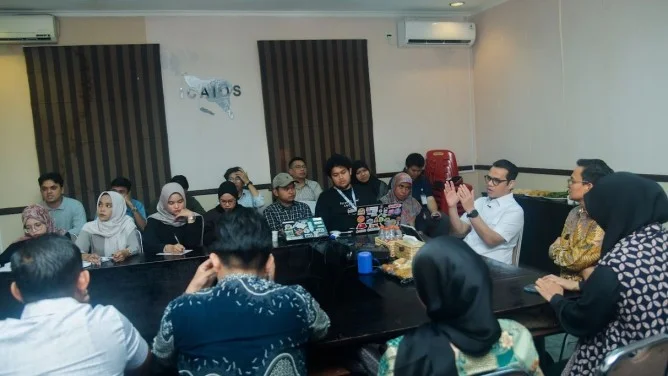
RRI.CO.ID, Jakarta - Deputy Minister of Communication and Digital Affairs Nezar Patria has urged Aceh to prepare human resources with strong capabilities in science, technology, engineering, and mathematics, known as STEM, as part of the region's readiness to face global technological competition and geopolitical shifts. The statement was received Sunday, 6 September 2026, based on remarks he delivered during a guest lecture at the International Centre for Aceh and Indian Ocean Studies at Syiah Kuala University in Banda Aceh.
According to Nezar, Aceh's location at the western tip of Indonesia gives the region a strategic role, since it sits directly along the Malacca Strait, one of the world's busiest shipping routes and a frequent flashpoint for tension. "We are right at the hotspot and choke point of the Malacca Strait. The potential for conflict there is also very high. We all need to prepare, we need to learn from nations that have adopted technology and worked hard to master science," he said.
He stressed that this strategic geography must be matched by adequate scientific and technological capacity. Aceh, he said, cannot simply remain a region that a major shipping route passes through. It needs human resources capable of understanding and mastering technology that increasingly determines a nation's strength. "We are the first point of contact. Whoever enters the Malacca Strait meets us first. So we should become the strongest anchor of the strait," he said.
To achieve that goal, Nezar said universities in Aceh have a key role to play. He pointed to Syiah Kuala University and the State Islamic University as institutions that could help prepare a generation with strong STEM skills. "We need solid knowledge, we need advanced science, and strong technology as well. I believe that with Syiah Kuala University and the State Islamic University here, we can guide our students to go deeper into STEM, that is science, technology, engineering, and math. That will be very important going forward," Nezar said.
He recommended that strengthening STEM education become a priority over the next five to fifteen years. He argued the need is urgent because global competition today is increasingly shaped by a nation's ability to master technology and science, not merely by its natural resources.
While emphasizing the importance of STEM, Nezar made clear this does not mean sidelining the social sciences. He said the two fields must advance in balance so Indonesia can build a complete set of capabilities to face technological change alongside shifting geopolitics. "It does not mean the social sciences are unimportant. They matter just as much, but we need balance because the gap between social science and STEM mastery has grown too wide. It should be more even," he said.
Nezar added that mastering technology has become inseparable from national competitiveness, spanning science, energy, semiconductors, artificial intelligence, and computing power. He said Indonesia holds strategic assets including natural resources, a large domestic market, and a sizable population, yet its computing capacity remains relatively small.
He also noted that the digital economy's contribution to Indonesia's gross domestic product still stands at around 10 percent, far below China, the United States, and Japan, where the figure reaches roughly 50 percent. For Aceh, he said, building STEM talent is therefore a long term investment so the region's strategic geography can move forward together with genuine command of knowledge and technology.
News Recomendation
Memuat berita terbaru.....