



National Archives Warn against AI-Altered Historical Records
- 28 Agt 2026 19:25 WIB
- Voice of Indonesia
Poin Utama
- ANRI warns that archives must remain authentic and must not be altered using AI.
- The challenge of archiving in the AI era lies in drawing a clear line between using AI as a tool and allowing it to alter historical sources.
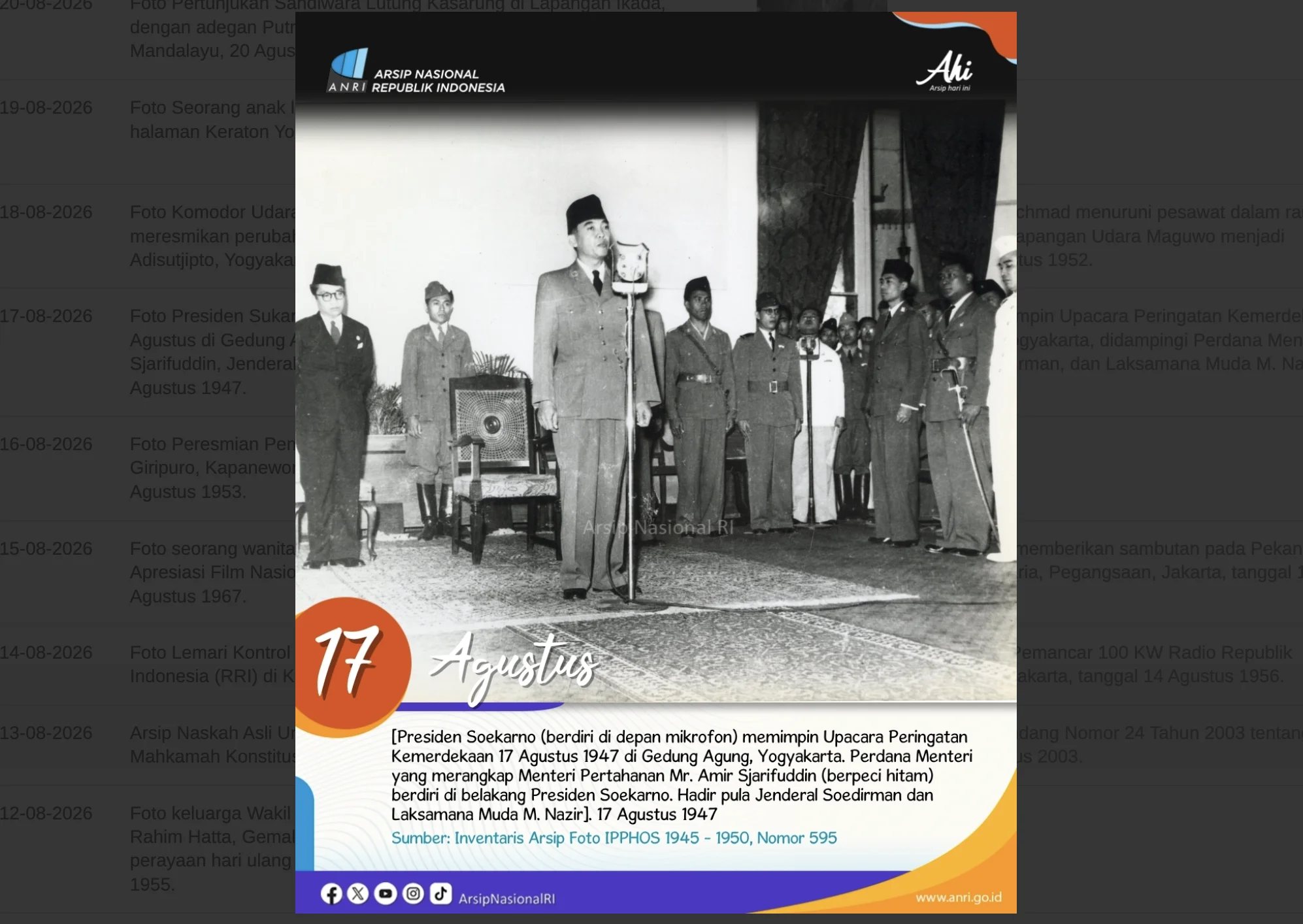
RRI.CO.ID, Jakarta - Advances in artificial intelligence (AI) present new challenges for archival management. Technology that can enhance, alter, or generate images and narratives within seconds must not compromise the core principles of archiving: authenticity and contextual integrity.
The National Archives of the Republic of Indonesia (ANRI) stressed that historical sources must remain genuine and cannot be modified using AI, as beautifying or altering them risks falsification.
ANRI Head Mego Pinandito warned the public to exercise caution when applying AI to documents or images with archival value.
“We must be careful these days. Take images, for instance -- people feed them into AI and, presto, it’s done. A photo may look incredibly beautiful or perfect simply because it has been polished by AI,” Mego said in Jakarta on Thursday, August 27, 2026, as quoted by Antara.
He emphasized that using AI to enhance or beautify photos contradicts archival processing principles. Records must remain verifiable and presented as they were when first created.
This principle also applies when archives are reused for educational purposes, such as in history lessons. Any narrative constructed from archival materials must be based on documented evidence to avoid distorting historical context.
“All archives serving as the basis for historical materials must be authentic and genuine, backed by documented proof,” he said.
Mego cited the compilation of materials on the Imam Bonjol War in West Sumatra as an example. If certain historical details require elaboration, verification must be sought from credible sources, including local government authorities.
Thus, AI cannot replace historical evidence. Archival materials -- whether handwritten notes, stories, photographs, or illustrations -- must be supported by clear sources and proof of their existence. AI may help present information, but it cannot fabricate evidence intended to pass as authentic archives.
“It could be a handwritten note or a story, provided there is existing evidence to support it. There may be accompanying photos or illustrations, but they must not be fabricated,” Mego said.
On the other hand, ANRI does not rule out the use of AI in education. According to Mego, teachers can leverage technology to engage students and help them understand historical material in a modern context.
Teachers may use technology to encourage students to retell historical events in their own words and styles. However, creative presentation must not alter the archival sources forming the foundation of the lesson.
“If teachers are not supported, they may revert to old-fashioned methods -- simply recounting stories -- rather than introducing technology,” he noted.
Therefore, the challenge of archiving in the AI era is not merely about whether technology should be used. The core issue lies in maintaining boundaries between using AI as a tool and allowing it to alter historical sources.
AI can help make learning more interactive, summarize information, or package material for easier comprehension. However, archival sources must remain authentic, evidence-based, and unaltered. Upholding this principle ensures technological advancement does not compromise archival authenticity or historical integrity. ***
News Recomendation
Memuat berita terbaru.....