



Indonesia Expands Shallot Exports From Brebes to Thailand
- 14 Sep 2026 17:07 WIB
- Voice of Indonesia
Poin Utama
- Shallots produced in Brebes, Central Java, are opening new market access through exports to Thailand.
- The government is also strengthening the domestic market by purchasing farmers’ shallots for the MBG program.
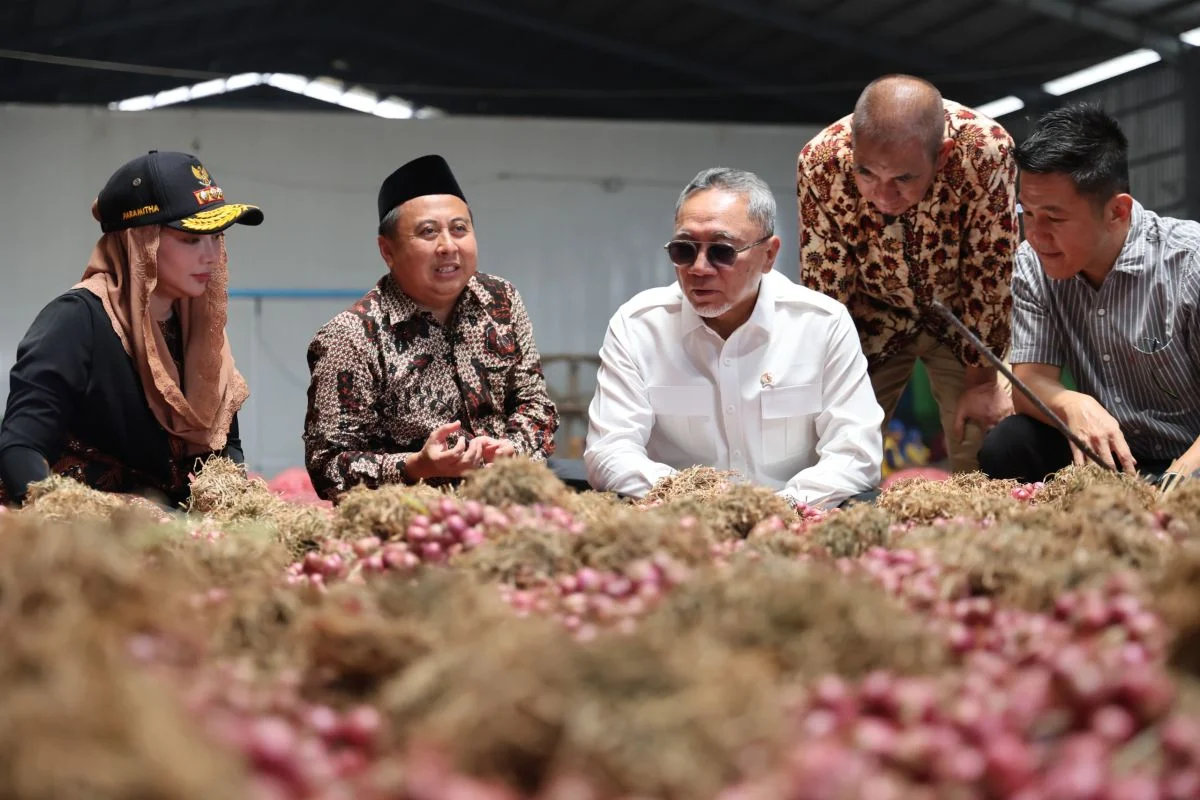
RRI.CO.ID, Jakarta - Shallots produced in Brebes, Central Java, have gained access to a new export market. Shipments to Thailand form part of the government’s efforts to ensure crop absorption while increasing the commodity’s economic value.
Coordinating Minister for Food, Zulkifli Hasan, said export expansion is carried out once domestic demand has been met.
“We are now pushing for production to continue increasing so that farmers can access broader markets and better prices, including export markets,” Minister Zulkifli said while inspecting and sending off a shipment of shallots to Thailand from a controlled atmosphere storage (CAS) facility in Brebes, Central Java, as reported by Antara on Monday, September 14.
Brebes shallots have previously been exported to Vietnam, Malaysia, and Singapore.
Brebes holds a strategic position in the national shallot supply chain. The regency accounts for around 20 percent of national production and 60 percent of Central Java’s output, with a cultivation area of 30,000–35,000 hectares per year and annual production of 300,000–350,000 metric tons.
According to Minister Zulkifli, increased production must be accompanied by market certainty and price stability. “We must ensure that farmers don’t end up producing a lot only to find there’s no market for it,” he said.
Projection data from the National Food Agency (Bapanas) indicate that national shallot production in 2026 is estimated at 1.32 million metric tons, exceeding consumption needs of around 1.25 million metric tons.
In 2025, production reached 1.43 million metric tons, with consumption at 1.23 million metric tons. The surplus enabled Indonesia to export 1,560 metric tons of shallots to global markets.
The government is also preparing the domestic market by purchasing shallots from farmers for the Free Nutritious Meals Program (MBG) administered by the National Nutrition Agency (BGN).
On the upstream side, the government is strengthening seedling production and productivity to support market expansion. Reducing dependence on imported seeds is part of the strategy to maintain supply and ensure that shallot quality meets the needs of both domestic and export markets. ***
News Recomendation
Memuat berita terbaru.....