



BKSDA Bali Supports Research and Development of Local Orchids
- 09 Sep 2026 16:50 WIB
- Voice of Indonesia
Poin Utama
- BRIN has documented more than 200 local orchid species in Bali, highlighting the island’s significant orchid genetic resource potential.
- The research titled “Adaptation and Development of Local Orchid Genetic Resources in Bali” involves the Bali Provincial Agriculture and Food Security Agency and Udayana University’s Faculty of Agriculture.
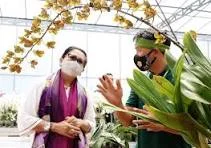
RRI.CO.ID, Denpasar - Bali’s floral wealth has once again captured the attention of the global botanical research community following the documentation of more than 200 local orchid species by the National Research and Innovation Agency (BRIN). This finding positions Balinese orchids as one of the largest potential genetic resource bases urgently requiring scientific exploration, documentation, and conservation.
Chairperson of the Regional Leadership Council (DPD) of the Indonesian Orchid Association (PAI) for Bali Province, Putri Koster, emphasized that developing Bali’s local orchids demands involvement and perspectives from multiple stakeholders.
She noted that the research project titled Adaptation and Development of Local Orchid Genetic Resources in Bali was conducted by the Bali Provincial Agriculture and Food Security Agency in collaboration with Udayana University’s Faculty of Agriculture. Furthermore, she conveyed that this initiative represents a strategic synergy between academia and the Bali Provincial Administration.
“This research activity is a synergy between academia, fully supported by the Bali Provincial Administration. We aim to revive the potential of Bali’s local orchids, which have largely remained unknown to the public. This is a treasure we possess and must reintroduce to society,” she said in Bali on Wednesday, September 9, 2026.
Putri Koster articulated an ambitious vision of integrating orchids into the daily life of Balinese communities. Within five years, she hopes every household in Bali will maintain an orchid collection, forming a collective movement with both conservation and economic value.
“Our dream is that within five years, every Balinese household will have an orchid collection. With support and synergy from various parties, I am confident this dream can be realized. Orchids are not only beautiful plants but can also provide economic benefits to the people of Bali,” she said.
An expert in biosystematics and evolution at BRIN, Aninda Retno Utami, underscored the substantial genetic resource potential of orchids in Bali. The documentation of over 200 orchid species confirms that Bali holds highly promising genetic resources warranting continued research, documentation, development, and conservation.
“Bali possesses immense potential in orchid genetic resources. From existing collections and documentation, more than 200 orchid species have been recorded in Bali. This is a significant treasure that we must explore further, both in terms of diversity, characteristics, and development potential,” said Aninda.
She expressed BRIN’s strong support for strengthening research and documentation of local Balinese orchids, noting that robust scientific databases would enable more informed conservation and sustainable development strategies across sectors.
“BRIN is certainly very open to supporting this synergy. Scientific data must be aligned with government policies, community knowledge, the role of universities, communities, and the business sector. Through such collaboration, we not only document Bali’s orchid wealth but also determine how this wealth can be conserved and utilized sustainably,” she added.
At the forum, the Bali Natural Resources Conservation Center (BKSDA) presented its conservation perspective, particularly regarding the protection, management, development, and utilization of plants and genetic resources. BKSDA Bali views the development of local orchids as a major opportunity to integrate conservation, research, education, community empowerment, and sustainable use.
Head of BKSDA Bali, Ratna Hendratmoko, said that local orchid research has great potential for further development beyond producing new varieties or hybrids. She added that it can serve as a model for managing local genetic resources to benefit both conservation and communities.
“In principle, we strongly support this research. In fact, this orchid research has the potential to become a model for genetic resource management that not only yields new varieties but also provides real benefits for conservation and society,” said Ratna Hendratmoko, often referred to as Moko.
He stressed that orchid development must be approached with a long-term perspective. Every stage, from research and documentation to development and utilization, should be linked to efforts that safeguard genetic resources and advance conservation interests.
“We hope the outcomes of this research will not only provide academic or economic benefits but also generate outputs that feed back into the conservation of local Balinese orchids. In other words, there must be benefits that return to the genetic resources that form the foundation of this research,” he continued.
BKSDA Bali emphasized the importance of connecting in-situ and ex-situ conservation to ensure research outside natural habitats is conducted responsibly without pressuring wild populations. At the same time, these development outcomes are expected to bring added value to local communities.
Orchids can be developed through education, conservation collections, community empowerment, and various tourism experiences that introduce Bali’s floral wealth to residents and visitors alike. For BKSDA Bali, such collaboration is critical because conservation cannot be achieved by a single party.
Administration, universities, research institutions, communities, associations, the business sector, and the younger generation all play complementary roles in both preserving and developing Bali’s rich genetic resources.
“If we work on this together, what we build is not just orchid research but a collaboration model for how Bali’s local genetic resource wealth can be protected, developed, documented, and utilized responsibly. Ultimately, the benefits must return to conservation and the community,” said Moko.
The research project is expected to serve as a starting point for establishing an integrated orchid development ecosystem. This ecosystem will connect aspects of research, conservation, community empowerment, policy, and utilization into a coherent framework. (Annaila Azzahra-EN)
News Recomendation
Memuat berita terbaru.....